 Let's Talk
Let's Talk
Let's Talk
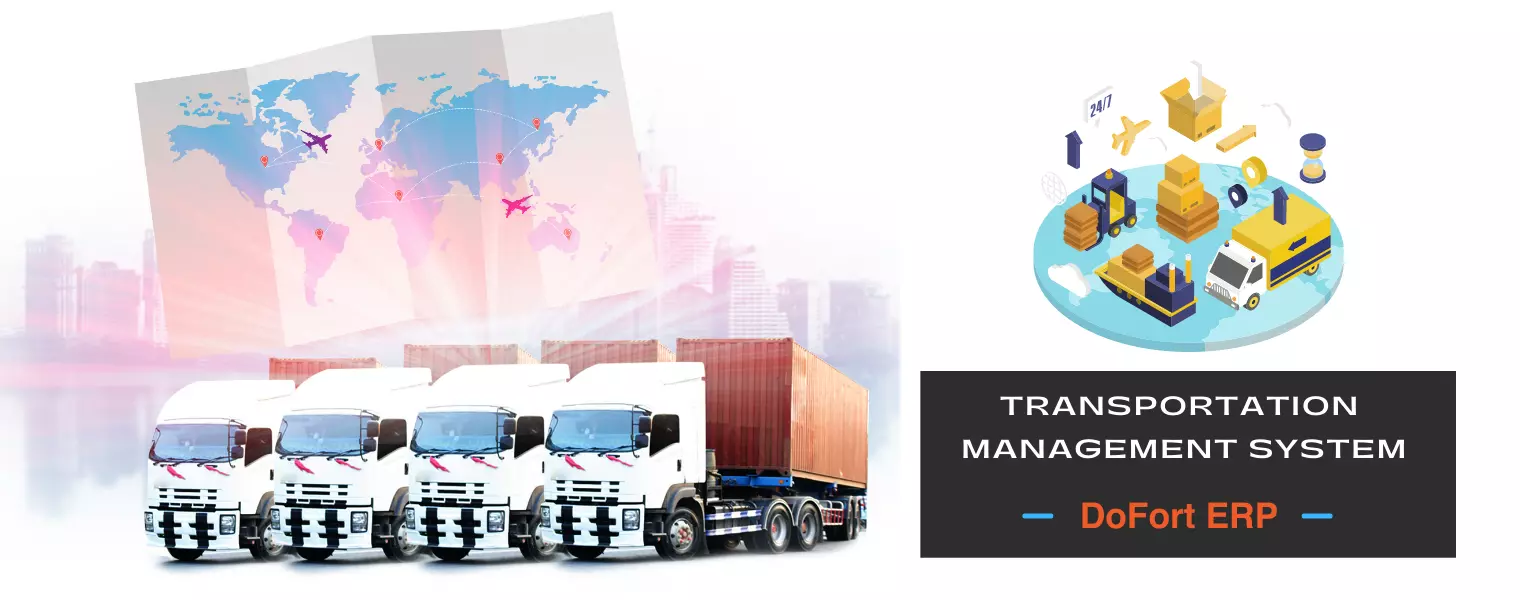
In the current inter-connected global economy, the capability to transport goods effectively, precisely, and economically has emerged as an
important source of competitive advantage. Transportation is involved in the entire supply chain, from procuring raw materials to the last-mile
delivery.
To deal with all these challenges, organizations are adopting Transport Management Systems (TMS), which is transportation-based ERP software,
and also logistics-based ERP.
The comprehensive resource details what a
Transportation Management System
is, its importance in logistics, important aspects of transport software, differences between transportation ERP and traditional TMS
solutions, and how a superior solution like DoFort EnterpriseX assists transportation/logistics businesses with complete digital
transformation.
Transportation Management System: This is an IT-based tool that aims to manage, control, and optimize the movement of products through the
supply chain. This system is also responsible for managing all sorts of transportation activities, including planning, routing, carriers,
billing, tracking, and analysis.
As opposed to a manual or independent system, a modern transportation ERP solution combines transportation, inventory, warehousing, financial,
order, and service functions for a complete view of logistics operations from a single source of truth.
When integrated with the technological capabilities of logistics software, a TMS is a strategic system that adds value to visibility,
automation, cost savings, and decision-making with respect to transportation.
The transportation and the logistics industry is constantly under pressure because of the rising costs of fuel, the advent of e-commerce, shrinking delivery times, and the expectations of customers. Organizations using spread sheets or legacy systems face the following challenges:
A contemporary transport ERP functions to meet these requirements by digitalization, automation of decision-making, and supply of real-time information on overall transportation performance.
Implementing a robust Transportation Management System delivers measurable improvements in efficiency, transparency, and profitability.
Now, transportation programming algorithms are not simply about finding the shortest distance between points. Contemporary transportation algorithms consider several factors, including traffic flows, delivery times, capacity, fuel prices, and the number of qualified drivers.
With intelligent route optimization, businesses can:
For fleet operators and logistics providers, this directly translates into cost savings and operational reliability.
Handling multiple carriers can be a time-consuming and error-prone process in a manual system. The TMS can manage carrier operations centrally by facilitating:
This enables the logistics organization to exercise its choice on the optimal and most economical way of shipping their cargo.
Real-time visibility has become a norm in the logistics industry. It can track transport and vehicles through the use of GPS/telematics.
Key advantages include:
This level of visibility empowers teams to resolve issues before they impact customers.
Transportation operations are carried out through documentation processes like bills of lading, delivery documentation, customs documentation, and compliance documentation.
A modern transportation management system:
Automation not only saves time but also significantly reduces compliance-related risks.
Transportation remains among the greatest cost centers when it comes to logistics-intensively involved sectors. There are several ways through which Transportation ERP Systems offer financial information:
With accurate, real-time data, decision-makers can implement cost-saving strategies without compromising service quality.
Customer expectations have undergone dramatic changes. Modern-day customers want transparency, dependability, and quick communication.
Transportation management systems improve customer service by:
This leads to higher customer satisfaction, retention, and brand trust.
Modern transportation software includes advanced analytics and reporting tools that provide insights such as:
These insights help organizations continuously refine their transportation strategies.
While considering the optimal transport management software or logistics ERP system for the company’s use, the following factors must be given utmost priority:
These capabilities ensure scalability, efficiency, and future readiness.
A traditional TMS mainly involves routing, execution, and tracking. Although it’s very helpful, it works independently.
A Transportation ERP, on the other hand, integrates logistics with:
It allows for full end-to-end operational visibility and decision making; hence, transportation ERP is a more robust and scalable process now.
Digital transformation in transportation sets out beyond automation. It brings systems together, removes data silos, and leverages data.
Transportation ERP supports digital transformation by enabling:
This allows transportation and logistics businesses to operate with agility, resilience, and data-driven confidence.
Choosing the proper transportation/ logistics ERP system depends on business scale, fleet, and future growth plans. Before finalizing a system, consider:
The best logistics software is one that evolves with your operational needs.
As transport and logistics business systems become more intricate, organizations require more than simply tools—they demand an integrated
digital Operating Platform.
DoFort EnterpriseX
is an effective transportation ERP solution that can assist logistics and transportation businesses in moving their operations and processes
towards digital transformation. Transport software solutions and logistics ERP have now become essential tools, as growth enablers, for
companies across the transport and logistics industry and others. As a totally competent solution with an industry-specific approach,
DoFort EnterpriseX proves itself as a perfect solution for transport and logistics companies planning for success in today's digital world.
Transportation software and logistics ERP are no longer optional and they are strategic enablers of growth. With its comprehensive capabilities and industry-focused design, DoFort EnterpriseX stands out as the ideal choice for transportation and logistics businesses ready to thrive in the digital era.
Welcome to DoFort !

