 Let's Talk
Let's Talk
Let's Talk
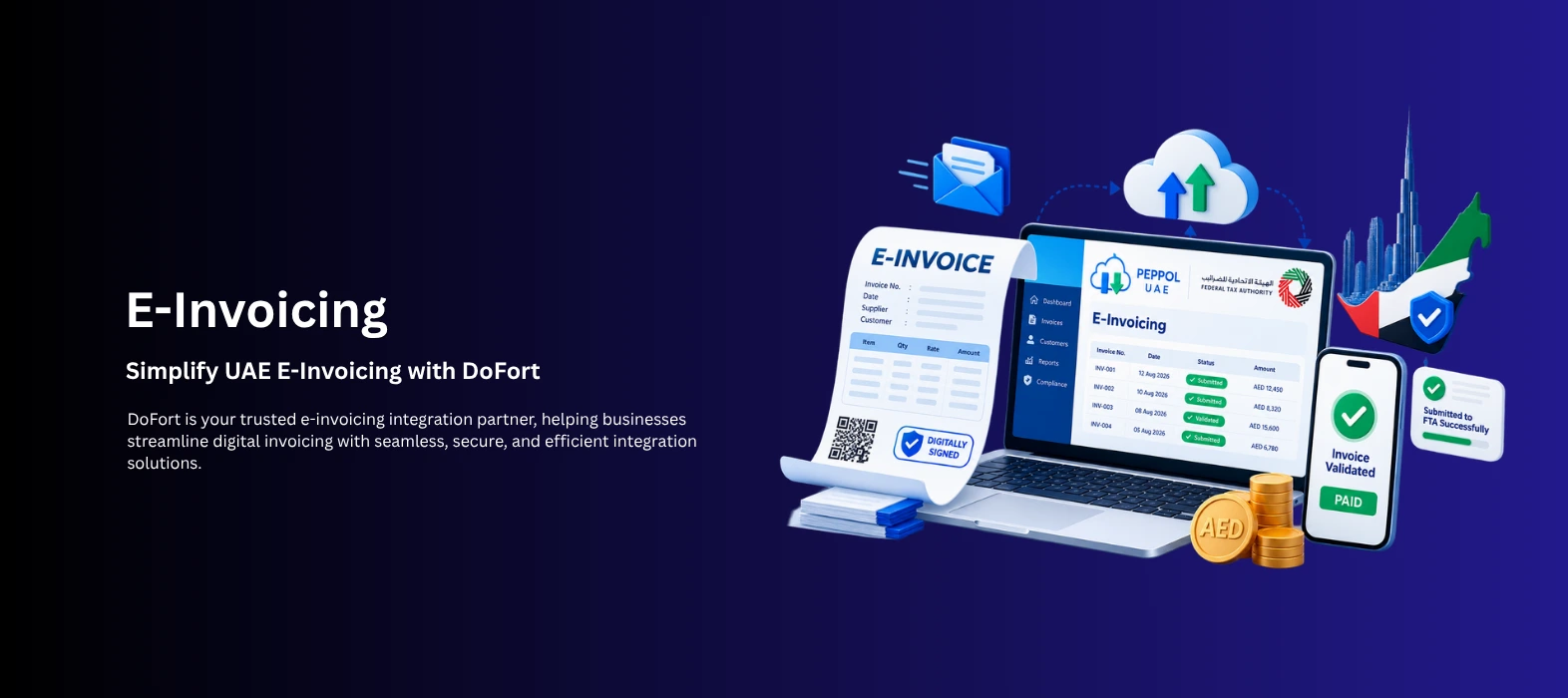
The UAE is transforming its financial and corporate landscape through
e-invoicing in UAE,
a major step in the country’s wider digital transformation and the “We the UAE 2031” strategy. Moving beyond
traditional paper and
PDF invoices,
the UAE Ministry of Finance (MoF)
and
Federal Tax Authority (FTA)
are
implementing a structured e-invoicing UAE framework based on the Decentralized Continuous Transaction Control and
Exchange (DCTCE) model.
For businesses operating in Dubai, Abu Dhabi, Sharjah, and across the UAE, UAE e-invoicing is more than a technology
upgrade—it is an important compliance and digital transformation requirement that can impact ERP systems, accounting
software, billing platforms, financial workflows, and day-to-day operations. Whether you are a multinational enterprise,
SME, or growing local business, understanding how e-invoicing works in the UAE, key implementation requirements,
timelines, and compliance obligations is essential for preparing your business for structured digital invoice exchange
and achieving long-term compliance and operational efficiency.
E invoicing is the electronic generation, validation, exchange, and reporting of invoice information in a structured, machine-readable format.
UAE e-invoicing
is a digital process for issuing, transmitting, and receiving invoices between suppliers and buyers in a
structured electronic format. Under the UAE
e-Invoicing
framework, e-invoices are generated and processed in structured XML format, enabling seamless and automated
data exchange between accounting and business systems. Unlike e-invoices, unstructured formats such as PDFs,
Word documents, images, scanned copies, and invoices sent by email do not qualify as
e-invoices.
The UAE e-Invoicing
system is based on the PEPPOL
5-Corner Model,
with the
Federal Tax Authority (FTA)
serving as the fifth corner for receiving and processing e-invoice data.
Under this framework, businesses must connect with an
Accredited Service Provider (ASP),
a technology provider recognised and accredited by the UAE Ministry of Finance (MoF). These ASPs facilitate the secure transmission of
e-invoices
between buyers and suppliers while helping businesses meet the UAE’s technical, regulatory, and compliance requirements.
Under the UAE Electronic Invoicing System (EIS) framework, UAE e invoicing is designed around structured and standardized invoice data.
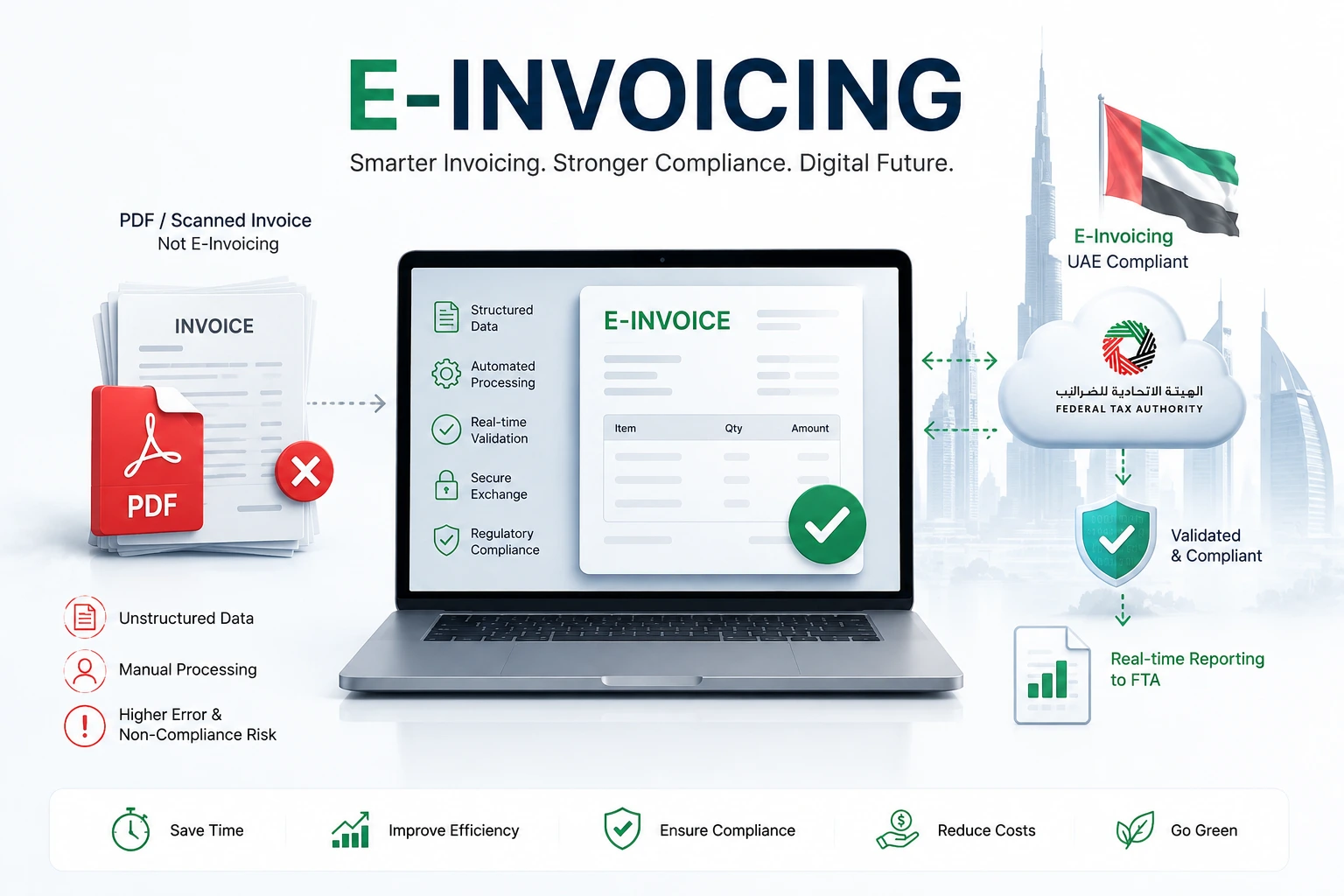
True eInvoices in the United Arab Emirates are generated using machine-readable and standardized formats, including XML-based structures designed to support automated processing and system-to-system data exchange.
The UAE e-invoicing framework follows internationally recognized electronic invoicing standards such as PINT-AE and Peppol-based frameworks to ensure seamless integration across the region.
UAE e-invoicing solutions are designed to undergo automated validation and schema checks before transmission. This helps businesses operating within the United Arab Emirates reduce manual data entry and identify critical compliance issues, such as:
The electronic invoice or UAE e-invoicing ecosystem supports secure digital exchange and reporting of relevant transaction data, helping businesses in the United Arab Emirates improve transparency, accuracy, and overall compliance visibility with local tax authorities.
The e-invoicing in UAE framework follows a decentralized model based on the international Peppol network approach. The UAE e-invoicing 5-Corner Model enables secure, standardized, and automated electronic invoice exchange between suppliers and buyers while supporting regulatory reporting and compliance requirements. The model connects business systems, accredited service providers, the Peppol network, and tax authorities to streamline e-invoicing in UAE and establish a secure, efficient, and compliant digital invoicing ecosystem for businesses.
The supplier generates the invoice within its existing business software, such as:
The transaction information is prepared for structured e-invoicing processing right from your local operations in the United Arab Emirates (UAE).
The supplier's Accredited Service Provider (ASP) processes the invoice data to support seamless validation, formatting, and secure transmission across the UAE. The ASP helps:
The ASP can help:
The buyer's accredited provider receives and processes the electronic invoice within the UAE network. The provider validates and routes the structured invoice data directly toward the buyer's internal business systems.
The buyer receives the verified e-invoicing in UAE document directly into their enterprise architecture:
This implementation minimizes manual invoice entry and significantly accelerates accounts payable automation for businesses operating across the UAE.
Relevant transaction data is reported directly through the UAE e-invoicing ecosystem to support strict regulatory transparency, real-time auditing, and compliance monitoring mandated within the UAE.
The robust 5-corner model establishes a secure, standardized flow of information between suppliers, buyers, accredited service providers, and government infrastructure across the United Arab Emirates (UAE).
The rollout of E invoicing UAE follows a phased implementation approach to give businesses time to assess their systems, integrate technology, and test their electronic invoicing workflows.
| Business category |
ASP deadline |
Go-live |
|---|---|---|
| ≥ AED 50M revenue | 30 Oct 2026 | 1 Jan 2027 |
| < AED 50M | 31 Mar 2027 | 1 Jul 2027 |
| Government entities | 31 Mar 2027 | 1 Oct 2027 |
Compliance Warning: Businesses should prepare for e-invoicing in UAE before their applicable implementation deadline. Failure to meet official registration, appointment, implementation, or compliance requirements may result in administrative consequences under applicable UAE regulations.
Book a Free ConsultationAn Accredited Service Provider (ASP) acts as an important technology bridge between your business systems and the electronic invoicing ecosystem. Selecting the right ASP and implementation partner can significantly affect the success of your E invoicing UAE integration.
When selecting an e-invoicing provider in the UAE, businesses should ensure that the solution supports the applicable requirements of the UAE Ministry of Finance (MoF) and the UAE e-invoicing framework.
Before implementing e-invoicing in the UAE, businesses should verify the provider's applicable authorization, accreditation, technical capabilities, and ability to support the required UAE e-invoicing standards and compliance requirements.
UAE e-invoices contain sensitive financial, tax, and business information. Businesses implementing e-invoicing in the UAE should ensure that invoice storage, transmission, and archiving processes provide appropriate:
The UAE e-invoicing framework and its technical requirements may evolve as implementation progresses. Businesses should therefore choose an e-invoicing solution in the UAE that can adapt to changes in regulations, invoice schemas, technical specifications, and integration requirements.
Working with an experienced UAE e-invoicing technology and implementation partner can help businesses maintain their systems as the regulatory and technical requirements develop.
An e-invoicing solution in the UAE should integrate seamlessly with a business's existing ERP, accounting, billing, and financial systems. Depending on the organization's technology environment, this may include:
This may include:
Strong ERP integration for UAE e-invoicing reduces manual data entry, improves invoice automation, supports accurate data exchange, and helps businesses streamline their e-invoicing processes in the UAE.
Implementing E invoicing UAE requires a strong understanding of ERP systems, financial workflows, structured data, and business process integration. DoFort helps businesses bridge the gap between existing software infrastructure and electronic invoicing requirements.
DoFort helps businesses in the United Arab Emirates (UAE) prepare their existing technology infrastructure for UAE e-Invoicing by integrating ERP, accounting, CRM, billing, and financial systems.
Our UAE e-Invoicing integration approach is designed to enable structured invoice data generation and electronic invoice processing while minimizing disruption to existing business workflows.
DoFort supports integration with:
The integration process helps businesses align their existing systems with UAE e-Invoicing requirements, enabling accurate invoice data exchange and supporting a more efficient electronic invoicing workflow.
Businesses across the UAE have different invoicing processes depending on their industry, business model, transaction volume, and organizational structure.
DoFort provides customized UAE e-Invoicing solutions for businesses managing complex financial processes, including:
Our implementation approach helps businesses map their financial and invoice data into structured formats required for e-Invoicing in the UAE, while supporting integration with existing ERP and accounting workflows.
As UAE e-Invoicing requirements evolve, businesses need to assess how electronic invoicing will affect their ERP systems, accounting platforms, data structures, and existing financial workflows.
DoFort supports businesses in the United Arab Emirates with technical and integration-focused e-Invoicing support, including:
This approach helps businesses prepare their technology infrastructure for UAE e-Invoicing, improve system readiness, and adapt their existing financial workflows to evolving electronic invoicing requirements.
Our specialists assess your existing invoicing infrastructure to determine your readiness for UAE e-invoicing implementation. This assessment identifies technical, financial, and compliance gaps across your current systems and workflows in the United Arab Emirates.
The assessment covers:
This UAE e-invoicing readiness assessment helps identify integration and compliance gaps before implementation, enabling businesses to prepare their systems for the upcoming e-invoicing requirements in the UAE.
DoFort helps businesses in the UAE understand the technical, integration, and operational requirements involved in selecting and onboarding an appropriate Accredited Service Provider (ASP) for e-invoicing in the UAE.
We assess your existing ERP, accounting, and financial systems to ensure they are prepared for structured e-invoicing workflows and secure electronic invoice exchange.
The onboarding preparation focuses on:
DoFort configures and integrates your ERP and financial systems to map relevant invoice information into the structured electronic invoice format required for UAE e-invoicing.
Our e-invoicing integration in the UAE can cover key invoice data elements, including:
This structured approach helps businesses prepare their existing ERP and financial systems for automated e-invoicing in the UAE, supporting accurate invoice data exchange and streamlined financial workflows.
Pilot testing is an essential stage of successful UAE e-invoicing implementation. Before full deployment, businesses in the United Arab Emirates can test sample transactions to verify that their ERP, accounting, and financial systems are ready for electronic invoice processing and data exchange.
Sample e-invoicing transactions can be used to verify:
Thorough UAE e-invoicing testing and validation helps identify technical issues before full implementation and supports a smoother transition to production.
Successful e-invoicing implementation in the UAE also requires finance, accounting, and operations teams to understand the new electronic invoicing workflow.
DoFort can help businesses prepare their teams for the transition by focusing on key operational and UAE e-invoicing compliance processes, including:
Proper employee training helps organizations in the United Arab Emirates manage the transition effectively and maintain efficient UAE e-invoicing operations after full go-live.
Implementing E invoicing UAE solutions can provide operational benefits beyond compliance.
Faster Invoice Processing: Automated invoice exchange can reduce manual processing and improve financial workflow efficiency.
Improved Data Accuracy: Structured invoice data can reduce errors caused by manual data entry.
Reduced Paperwork: Digital invoice processing reduces dependence on traditional paper-based invoicing processes.
Better Financial Visibility: Businesses can gain improved visibility into invoice status and transaction information.
Improved ERP Automation: e-invoicing can support better connectivity between sales, accounting, finance, procurement, and ERP systems.
Enhanced Compliance Readiness: Standardized invoice structures and automated validation can help businesses maintain more consistent financial records.
e-Invoicing in the UAE is an important step in the country's digital transformation of business transactions, financial processes, and tax compliance. As businesses prepare for the evolving UAE e-invoicing framework, early system readiness can help reduce implementation challenges and improve operational efficiency.
Preparing your ERP, accounting, billing, and financial systems in advance can help your organization:
DoFort helps businesses assess their current infrastructure and develop a practical UAE e-invoicing implementation
roadmap. Our approach covers readiness assessment, ERP and accounting system integration, structured invoice data
mapping, testing, validation, and go-live preparation.
Whether your organization operates in Dubai, Abu Dhabi, Sharjah, or elsewhere in the United Arab Emirates, our
team can help you understand the technical requirements involved in preparing your existing business systems
for e-invoicing in the UAE.
Prepare your ERP and financial systems for the transition to UAE e-invoicing with DoFort. Build a structured implementation roadmap designed around your existing technology, business processes, and future electronic invoicing requirements.
DoFort helps businesses assess, integrate, test, and prepare their existing systems for the evolving e-invoicing UAE ecosystem.
Whether your business operates in Dubai, Abu Dhabi, Sharjah, or anywhere in the UAE, DoFort can help you build an effective roadmap for UAE e invoicing readiness.
Prepare your business for e-invoicing with DoFort and take the next step towards automated, structured, and digitally connected financial operations.
Welcome to DoFort !

